Does a Body Art Rug Have to Show the Whole Body?
Key Takeaways
- Body art rugs often change the color or drawing style while keeping the figure largely complete.
- Human figure rugs present a recognisable person; body part rugs allow one cropped detail to carry the image.
- A waist, breast or bum can remain recognisable through a few carefully placed curves.
- Body parts begin to read as abstract floor art when color, scale and negative space compete with anatomy.
- Nico’s compact rectangular format works where a larger human figure could overwhelm the available floor.
Search for a body art rug and the body is usually given to us almost in full. Some designs use thermal color, others reduce the figure to a silhouette or a few continuous lines, but the head, torso and limbs still explain what we are looking at.
There is nothing wrong with showing the whole figure. The repetition becomes interesting when changing the art style appears to be the main source of variety. The colors change. The line becomes thicker or thinner. The pose shifts. Yet the body still arrives as one complete subject.
What happens when most of it disappears? Can a waist be recognised from two inward curves and a navel? Can a breast or bum become a graphic shape before the body registers? The Nico rugs begin with those questions, cropping the figure until only a few deliberate clues remain.
Why do body art rugs so often show the whole figure?
A complete figure is quick to understand. Even at thumbnail size, the relationship between the head, torso and limbs tells us that we are looking at a person. Thermal color can make that figure louder, a silhouette can remove its detail, and continuous line art can simplify its surface. The underlying subject remains easy to recognise.
That clarity is useful in a crowded image grid. A shopper does not need to study the product before deciding whether it belongs to the body art category. Suppliers can also change colors, poses and drawing styles while preserving a format that has already proved legible.
The result is more varied than it first appears, but less varied than it could be. A thermal body rug and a body line art rug may look very different beside one another, yet both often depend on enough of the body being present to explain the image immediately.
The June swimming girl rugs approach the complete figure through movement. Arms, legs, clothing and direction show a woman in the middle of an activity, an idea explored in Not Every Woman Shaped Rug Has to Be a Thermal Body Rug. Nico asks a different question: how much of that figure needs to remain at all?
Across the Body Art Rugs Collection, the two series offer separate ways into the same subject. June changes what the figure is doing. Nico crops the body until a few lines and shapes have to do all the work.
Human figure rugs vs body part rugs
A human figure rug gives the eye a person to follow. The figure may be drawn in one line, filled as a silhouette or broken into thermal color, but the body remains broadly complete. We recognise the person first, then notice how the artist has chosen to depict them.
A body part rug reverses that order. A curve, circle or block of skin tone may register as a graphic form before its anatomical meaning becomes clear. The missing body is part of the composition because the viewer has to complete it mentally.
Cropping also changes the role of the rug’s edges. On a human figure rug, the rectangular border often frames a finished drawing. On a body part rug, the border appears to cut through a larger body that continues beyond it. What has been left outside the frame carries almost as much weight as what remains inside.
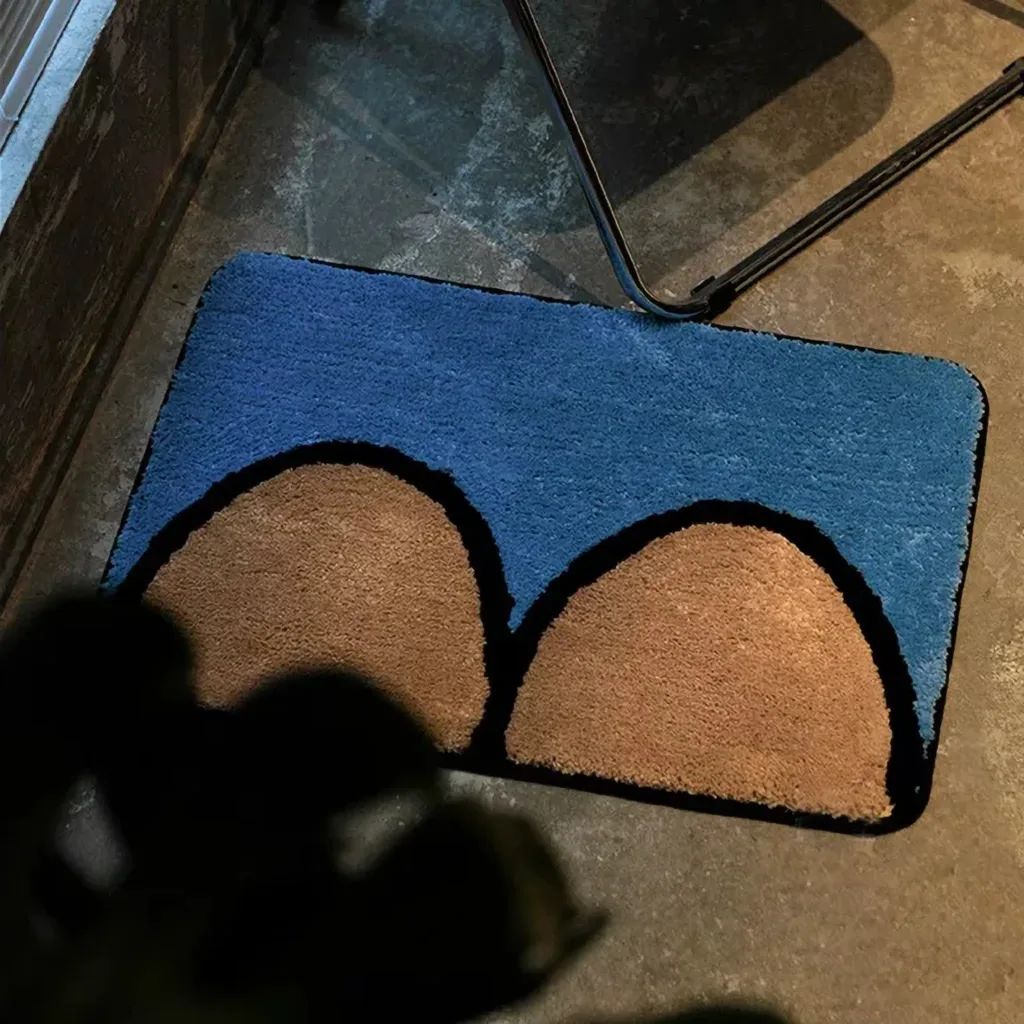
The Nico Blue & Tan Graphic Abstract Breast Body Art Tufted Rug makes that difference easy to see. Two tan forms rise from the lower edge, divided and contained by a black outline against blue. There is no face, torso or pair of arms to introduce the subject. Shape, placement and symmetry provide enough information for the body part to become recognisable.
The image can still be read before that recognition happens. From further away, blue occupies most of the rectangle and the tan forms sit like two rounded graphic blocks. The anatomical reference appears on a second look, giving the rug a different rhythm from a complete figure that explains itself immediately.
How much of the body do we need to recognise it?
Very little, provided the remaining clues are specific enough. Our eyes already know where a waist narrows, how two curves suggest the lower back or how a navel fixes the orientation of a torso. A designer can remove most of the body and rely on those familiar relationships.
The Nico Beige & Tan Graphic Abstract Waist Body Art Tufted Rug strips the figure back to two inward black lines and a small central navel. No head, limbs or shoulders are needed. The narrowing curves tell us where the waist sits, and the navel confirms which part of the body we are seeing.
Its beige ground keeps the contrast quiet, so recognition depends less on a dramatic palette and more on the position of each mark. Remove the navel and the composition becomes harder to place. Straighten the curves and the waist begins to disappear. A few details may be enough, but each one has a precise job.
The Nico Gray & Tan Graphic Abstract Bum Body Art Tufted Rug works differently. Its paired curves enter from one side of a blue-gray rectangle, leaving much of the remaining surface open. The body feels larger than the rug because the crop suggests that the figure continues beyond the frame.
Here, recognition comes from direction as well as shape. The curves do not sit neatly at the center like an isolated icon. They arrive from the edge, so the rug feels like one close section of a larger image. Beige Waist uses symmetry and the navel to identify the body. Gray Bum uses rounded volume, placement and an abrupt crop.
Neither design needs to show more. Adding the rest of the torso would make the subject easier to name, but it would also remove the moment when the viewer moves from abstract shape to body recognition.
When does a body part rug become abstract floor art?
A body part rug starts to feel abstract when anatomy stops being the only thing holding our attention. Background color, proportion and the relationship between shapes become strong enough to compete with the subject.
The Nico Purple Graphic Abstract Male Body Art Tufted Rug pushes furthest in that direction. From across the room, its composition can be read as two tan circles and one vertical form enclosed by black against a purple rectangle. The arrangement has the directness of a simple symbol.
Move closer and the male-body reference becomes harder to miss. That recognition does not cancel the geometry. Both readings remain present, which is where the design gains its tension. It can be cheeky and explicit in meaning, yet visually controlled through symmetry and reduction.
Purple matters here because it establishes a strong field around the tan forms. The background is not empty material carrying an illustration. It occupies most of the image and determines how strongly the central shapes project into the room.
The same principle applies beyond body art. A graphic rug can change a plain area of floor through one concentrated arrangement of color and shape, a relationship explored further in Why Graphic Rugs Make Plain Rooms Feel More Alive?.
Abstract does not have to mean unrecognisable. In Nico, abstraction comes from seeing two things at once: a specific body part and a compact arrangement of curves, circles and color.
Where does a graphic body rug work in a room?
Nico behaves differently from a shaped human figure rug. Its image stays inside a compact rectangle, so it does not need a wide ring of visible floor to make an arm, leg or head readable. The composition already has its own frame.
That makes the series useful in smaller areas where a complete figure could feel too long or visually busy. Beside a bed, under a dressing table, near a desk or next to a reading chair, the rectangle can occupy one local patch of floor without pretending to be the room’s main area rug.
The strongest placement depends on how the rug is first seen. Blue, gray and purple backgrounds can catch the eye from a doorway, with the body reference becoming clearer as someone moves into the room. The quieter beige waist design relies more on its black curves and suits a position where it will be seen from closer range.
Furniture can sit near the rectangular border, but it should not cover the few marks that make the image readable. Hiding the navel on Beige Waist removes one of its most useful clues. Covering one of the paired forms on Blue Breast changes the balance that allows the body part to emerge.
In a compact US bedroom, an open strip beside the bed or dressing table is often enough. A reading corner can support a bolder color because the rug has a chair or small table to relate to. Near a desk, the rectangular shape follows the furniture naturally, while the cropped body keeps the floor from feeling like an extension of the workspace.
The aim is not to create a gallery around the rug. It only needs enough visible surface for the color field and central motif to be understood together.
Body art rugs beyond the whole figure
Body art can begin with a complete person, but it does not have to stop there. A figure in motion tells us who someone is through posture and activity. A cropped body part works differently, asking which lines and shapes make the body recognisable in the first place.
Nico reduces that information four ways. A pair of rounded forms suggests a breast. Two inward lines and a navel establish a waist. Curves entering from the edge imply a larger body beyond the frame. Three simple forms turn a male motif into something close to a geometric symbol.
Those designs do more than remove parts of a figure. They change how the image is read. The viewer may notice blue, gray, beige or purple first; then the outline; then the body. Recognition takes a moment, and that moment becomes part of the rug.
The
Body Art Rugs Collection brings these visual languages together, from complete figures in motion to cropped body parts reduced to line, shape and color.